You have an AI agent that works. Now your users want it as a physical thing. This guide walks through every decision — architecture, chip selection, form factor, prototyping, and production — with real numbers from devices that actually shipped.
Your AI agent app has traction. Users talk to it daily. Retention curves look good. But somewhere in your user feedback, a pattern emerges: people want the agent available without opening a phone. They want it always-listening on their desk. They want it clipped to their shirt. They want a physical button that means "I'm talking to you now."
This is the moment most software teams go wrong. They assume hardware is just a container for their software — pick a chip, 3D-print a case, ship it. The graveyard of AI hardware (Humane, Rabbit, dozens of Kickstarter ghosts) proves otherwise.
But it doesn't have to be that way. Plaud Note crowdfunded over $3 million and hit $10M+ monthly revenue by Black Friday 2025. The Friend pendant sold out its first batch. Ray-Ban Meta shipped 7 million units. Each of these started as an insight about what users wanted to hold in their hands.
This guide is the technical playbook for that journey — from "we have a working agent" to "we have a device on a shelf."
Step 1: Decide Where the AI Runs
This is the single most important architectural decision you'll make, and it determines everything downstream: BOM cost, battery life, thermal design, form factor, and even your business model.
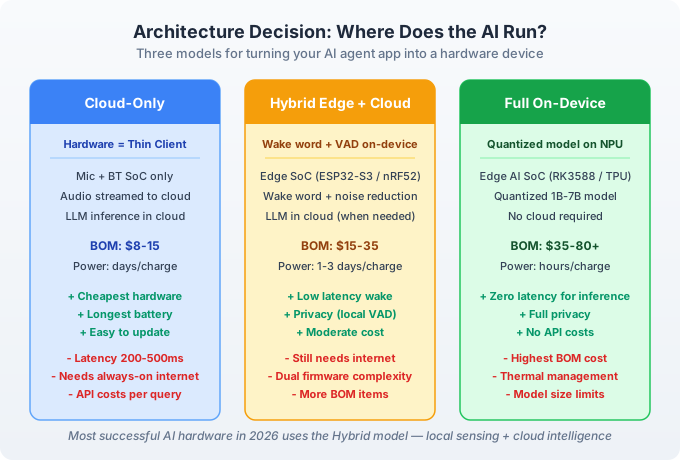
Three valid architectures. Most successful AI hardware in 2026 uses the hybrid model — local sensing and wake-word detection on-device, heavy LLM inference in the cloud.
Option A: Cloud-Only (Thin Client)
Your hardware is essentially a microphone, a Bluetooth SoC, a battery, and a button. Audio is streamed to your cloud API, where the LLM runs. The device receives the response and plays it back through a speaker or sends it to the phone.
What's inside: Nordic nRF52810 ($2-4) or similar BLE SoC, MEMS microphone ($0.50-1), small battery, minimal enclosure. Total BOM: $8-15.
Pros: Cheapest hardware. Longest battery life (days, not hours). Easy software updates — your agent improves without firmware pushes.
Cons: 200-500ms latency on every interaction. Requires always-on internet. You pay API inference costs per query, which scale with users.
Who this works for: Audio recording devices (Plaud Note, Omi pendant), companion devices that pair with a phone, any product where the hardware's job is capture, not intelligence.
Option B: Hybrid (Edge Sensing + Cloud Intelligence)
This is where most successful AI hardware lives in 2026. The device handles wake-word detection, voice activity detection (VAD), noise reduction, and possibly local speech-to-text on an edge SoC. When the user asks a complex question, audio or text is sent to the cloud LLM for inference.
What's inside: ESP32-S3 ($1.50-3) or Realtek RTL8722CSM ($3-5) for edge processing, MEMS microphones, Bluetooth/WiFi radio, moderate battery. Total BOM: $15-35.
Pros: Fast wake response (sub-100ms). Privacy-preserving — raw audio never leaves the device unless the user activates it. Moderate cost. Still allows cloud-side model improvements.
Cons: Dual firmware complexity (edge + cloud coordination). More BOM components to source and test. Still needs internet for full agent capability.
Who this works for: AI pendants, smart recorders, wearables with conversational interfaces. This is the architecture Plaud Note, Friend, and most 2026 AI hardware actually use.
Option C: Full On-Device Inference
Your device runs a quantized model locally on an NPU-equipped SoC. No cloud required for inference. The user gets zero-latency, fully private AI.
What's inside: Rockchip RK3588S ($25-40) with 6 TOPS NPU, or Qualcomm Snapdragon Wear Elite ($15-30, requires volume commitment), plus sufficient RAM (4-8GB for a 7B quantized model), thermal management, larger battery. Total BOM: $35-80+.
Pros: Zero cloud latency. Full privacy. No per-query API costs. Works offline.
Cons: Highest BOM cost. Thermal management becomes a real engineering challenge — running a 7B model generates heat. Battery life measured in hours, not days. Model updates require firmware pushes. You're limited to models that fit in your device's memory.
Who this works for: Premium devices with specific privacy or latency requirements. Robotics. Enterprise devices where cloud connectivity is unreliable. Most consumer AI hardware does NOT need this — the cost and complexity aren't justified by the user experience gain.
Step 2: Select Your SoC
Once you've chosen your architecture, chip selection narrows quickly. Here's the 2026 landscape for consumer AI hardware:
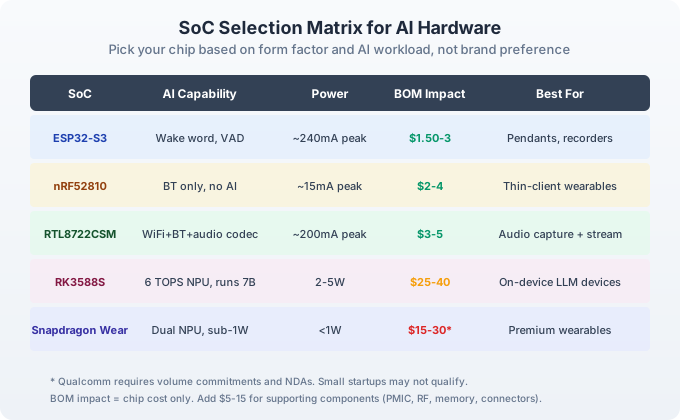
Chip cost is only the beginning. Add $5-15 for supporting components: PMIC, RF front-end, memory, connectors, and passives.
The Practical Decision Framework
If your device is a thin-client wearable (Option A): You need a Bluetooth SoC, not an AI chip. The Nordic nRF52810 family is the industry standard — it's what Plaud Note uses for its Bluetooth connection. At $2-4 per chip in moderate volumes, it's hard to beat. The nRF52840 variant adds USB and more GPIO if you need it.
If your device does local sensing (Option B): The ESP32-S3 from Espressif is the default choice. At $1.50-3, it includes WiFi, Bluetooth, and enough processing power for wake-word detection and basic audio processing. It has a massive open-source ecosystem — the xiaozhi-esp32 project on Gitee demonstrates a complete voice assistant built on ESP32-S3 connecting to cloud LLMs via MCP protocol. If you need better audio codec integration, the Realtek RTL8722CSM adds an onboard audio codec, WiFi, and Bluetooth in a single $3-5 chip — this is what Plaud Note uses for its core processing.
If your device runs models on-device (Option C): You're in a different world. The Rockchip RK3588S offers 6 TOPS NPU performance at $25-40 and can run a quantized 7B model. For wearables, the Qualcomm Snapdragon Wear Elite (announced MWC 2026) offers dual NPUs at sub-1W power — but Qualcomm requires volume commitments and NDAs that many startups can't meet. For prototyping, NVIDIA Jetson Thor developer kits ($3,499) are overkill but demonstrate what's possible — 1,035 TOPS, running 35B parameter models at 35 tokens/second.
What Plaud Note Actually Uses (Real Teardown)
The Plaud Note is the most successful AI hardware device of 2025-2026. A teardown reveals exactly how a winning product is built:
| Component | Part | Function | Est. Cost |
|---|---|---|---|
| Bluetooth SoC | Nordic nRF52810 | BT 5.0 connection to phone | $2-3 |
| Main SoC | Realtek RTL8722CSM | WiFi, BT, audio codec, app logic | $3-5 |
| Flash (firmware) | Puya PY25Q32HB (32Mbit) | Stores firmware configuration | $0.30 |
| Storage | Longsys FEMDNN064G-A3A55 (64GB) | Stores recorded audio | $3-5 |
| Microphones | 2× MEMS (S3182) + 1× bone conduction | Audio capture + call recording | $2-4 |
| Battery | ZWD 400mAh (3.8V) | Power | $1-2 |
| Haptics | Linear vibration motor (7mm) | Recording feedback | $0.50 |
| Enclosure | CNC aluminum | Product housing | $3-8 |
| Total estimated BOM | $15-30 |
Plaud sells for $159-179. That's roughly 5-6x BOM — exactly the ratio a healthy hardware product needs. The device uses a hybrid architecture: local audio capture and storage on-device, AI transcription and summarization in the cloud via GPT-4.1, Claude 4, or Gemini 2.5 Pro.

The ESP32 dev board. At $1.50-3 per chip, it's the starting point for most hybrid AI hardware prototypes. WiFi + Bluetooth + enough compute for wake-word detection and audio processing. (Photo: CC via Wikimedia Commons)
Step 3: Define Your Form Factor
Form factor isn't a design decision. It's a use-case decision. The question isn't "what shape should our device be?" — it's "what is the user doing when they interact with our agent?"
| Form factor | Interaction mode | Battery target | Key constraint |
|---|---|---|---|
| Pendant / pin | Always-present, hands-free | 1-3 days | Weight (<30g), water resistance |
| Card / wallet insert | On-demand, deliberate | 1-2 weeks | Thinness (<5mm), MagSafe integration |
| Desk device | Ambient, voice-activated | Always plugged in | Speaker quality, microphone array |
| Wristband | Continuous monitoring | 1-2 days | Skin contact, sweat resistance |
| Glasses / wearable | Always-on vision/audio | Full day | Weight distribution, heat near skin |
Plaud Note chose a credit-card form factor (29.5g) because its primary use case is meeting recording — you slide it out of your wallet, place it on the table, and press record. The Friend pendant chose a necklace form factor because its use case is emotional companionship — always present, always listening, always there.
The form factor rule: Your device must be usable with zero friction at the moment of need. If the user has to find it, turn it on, and wait for it to connect before they can interact, you've already lost.
Step 4: Build Your Prototype (2-4 Weeks, $500-3,000)
You don't need a factory to build your first hardware prototype. You need a dev board, a 3D printer, and a weekend.
Week 1: Hardware Breadboard
Order an ESP32-S3 dev kit ($8-15), a MEMS microphone breakout ($3-5), a small speaker or buzzer ($2-3), and a battery with a charging module ($5-10). Wire them together on a breadboard. Flash your agent's client code. Prove that your agent can receive audio, send it to your cloud API, and play back a response.
Week 2: PCB Design
Once your breadboard works, design a custom PCB. Use KiCad (free, open-source) or Altium (professional, expensive). For your first PCB, keep it simple: 2-layer, standard FR-4, through-hole or large SMT components you can solder by hand. Upload Gerber files to JLCPCB — 5 boards for $2, delivered in 24-48 hours. SMT assembly for 5 boards with your BOM: $200-400.

The ESP-WROOM-32 module: the building block of modern AI hardware prototypes. WiFi + Bluetooth + dual-core processing in a $2 module. (Photo: CC via Wikimedia Commons)
Week 3-4: Enclosure and Integration
3D-print your enclosure. Send an STL file to any Shenzhen printing shop via WeChat, pick up the part next morning for $15-50. Iterate on fit and feel. If you need metal (for premium feel or thermal dissipation), CNC machining from a local shop costs $80-150 per part with 3-4 day turnaround.
At this point, you should have 3-5 functional prototypes that look and feel like real products. This is your POC (Proof of Concept). It's not production-ready, but it proves your architecture works.
Step 5: From Prototype to Production
This is where the software-to-hardware transition gets real. Your POC works on your desk. Now you need to make 100, then 1,000, then 10,000 identical units that work in customers' hands.
EVT (Engineering Validation Test) — 3-4 weeks, $4,000-12,000
Design your production PCB: 4-layer, proper SMT components (0402 minimum), test points for production-line testing. Get 10-30 units assembled by a contract manufacturer. CNC-machine your enclosure in the final material. Test everything: audio quality, battery life, thermal performance, RF range.
DVT (Design Validation Test) — 6-10 weeks, $15,000-35,000
Cut aluminum soft molds ($2,000-8,000 per part). Produce 50-100 units. Run EMC pre-scanning ($1,500-2,500). This is where you discover that your microphone placement picks up too much handling noise, or your battery dies after 6 hours instead of the planned 12, or your WiFi range is 3 meters instead of 10.
PVT (Production Validation Test) — 4-8 weeks, $30,000-80,000+
Steel production molds ($6,000-20,000+). 200+ units on a real assembly line. Full packaging. This is your dress rehearsal. If PVT units pass, you're ready for mass production.

Inside a pick-and-place machine: the automated system that places components on your PCB at production speed. Small-batch SMT assembly in Shenzhen starts at $300 for 10-30 boards. (Photo: CC BY-SA via Wikimedia Commons)
Step 6: Don't Forget the Software Side
Your hardware is only half the product. The other half is the firmware, the cloud API, the mobile app, and the OTA (over-the-air) update system.
Firmware architecture
Your firmware needs three layers:
- HAL (Hardware Abstraction Layer): Drivers for your SoC, microphone, speaker, battery management, buttons. This is where ESP-IDF (for ESP32) or Nordic nRF SDK (for nRF52) does the heavy lifting.
- Application layer: Your agent's client logic — wake word detection, audio capture, encoding, cloud API calls, response handling, local state management.
- OTA update system: You will ship bugs. You need a way to push firmware fixes without bricking devices. Implement dual-bank OTA: download new firmware to a spare partition, verify checksum, swap on reboot. If the new firmware crashes, auto-rollback to the previous version.
Cloud architecture
Your cloud API needs to handle:
- Audio streaming (WebSocket or gRPC, not REST)
- LLM inference (your own model or API calls to OpenAI/Anthropic/Google)
- User authentication and device pairing
- Conversation history and context
- Rate limiting and abuse prevention
Budget $0.01-0.05 per interaction for cloud API costs if you're using commercial LLM APIs. At 50 interactions per day per user, that's $0.50-2.50 per user per month — which must be factored into your pricing model.
The Budget Reality Check
| Phase | Time | Budget |
|---|---|---|
| POC (dev board + 3D print) | 1-2 weeks | $300-1,500 |
| EVT (custom PCB + CNC enclosure, 10-30 units) | 3-4 weeks | $4,000-12,000 |
| DVT (soft tooling + EMC, 50-100 units) | 6-10 weeks | $15,000-35,000 |
| PVT (hard tooling + pilot run, 200+ units) | 4-8 weeks | $30,000-80,000+ |
| FCC + CE certification | 6-10 weeks (parallel) | $15,000-40,000 |
| Total, concept to pilot production | 4-6 months | $70,000-120,000 |
These are Shenzhen prices with an experienced local partner. If you're doing this from San Francisco without on-the-ground support, double the timeline and triple the cost.
"Your AI agent doesn't need a body. It needs a reason to have one. Figure out the reason first — the hardware follows."
Ready to give your agent a body?
We've helped AI software teams navigate the transition from cloud-based agents to physical products — from chip selection and PCB design to factory selection and mass production in Shenzhen. Whether you have a working prototype or just a hypothesis about what your users want to hold, we can map the path forward.
Book a Free 15-Minute Project Assessment →
No commitment. No pitch deck. Just practical feedback on your hardware feasibility from people who've been inside the factories.
Whether you have a working prototype or just a hypothesis about what your users want to hold, Aixumo can map the path forward.
Share your current stage. We'll help you identify the hardware route, productization risks, and the practical next move before you spend money on the wrong supplier conversation.